
four patterns in Q2 filings



The $16.3 billion in Bitcoin ETF positions that CryptoSlate recently tracked ahead of the Q2 filing deadline resolved into four disclosed position patterns.
Two Abu Dhabi filers held their ordinary ETF share counts steady, JPMorgan increased ordinary spot-ETF units, UBS shifted its disclosed long-options mix, and Morgan Stanley reduced external ETF units as a new branded wrapper appeared in its filing.
The result answers CryptoSlate’s pre-deadline Bitcoin ETF stress test within strict limits. The five filings arrived from Aug. 12 through Aug. 14, but each freezes reportable positions at June 30. Form 13F captures long securities and some held options while omitting short positions and written options, leaving each manager’s complete hedge book outside the frame.
The wider Bitcoin ETF complex recorded about $4.89 billion of net outflows during Q2, based on CryptoSlate’s calculation from Farside Investors’ daily table. About $2.06 billion of those net outflows came in the final five trading sessions of June. The quarter-end filings show how unevenly that pressure appeared across reported holders and instruments.
Bitcoin ETF holdings: the four-way map
Adding these rows to a single exposure total would mix owned fund units with option underlying equivalents and a separately branded wrapper. Kept in their proper categories, the filings show four distinct responses to the same drawdown.
CohortFiler and instrumentQ1Q2Reported changeSovereignMubadala, ordinary IBIT shares14,721,91714,721,917No net changeSovereignAbu Dhabi Investment Council, ordinary IBIT shares8,218,7128,218,712No net changeBank-managedJPMorgan, ordinary spot-ETF shares8,462,88310,623,591+2,160,708, or 25.53%Options-ledUBS, ordinary spot-ETF shares365,894414,191+48,297, or 13.20%Options-ledUBS, IBIT call / put underlying equivalents80,000 / 303,3001,950,000 / 143,300Calls +1,870,000; puts -160,000Bank and wrapperMorgan Stanley, external spot-ETF shares19,411,35618,636,055-775,301, or 3.99%Bank and wrapperMorgan Stanley Bitcoin Trust sharesNot reported2,570,6272,570,627 newly reported
Sources: Morgan Stanley Q1 and Q2; JPMorgan’s amended Q1 restatement and Q2 filing; UBS Q1 and Q2; Mubadala Q1 and Q2; and Abu Dhabi Investment Council Q1 and Q2.
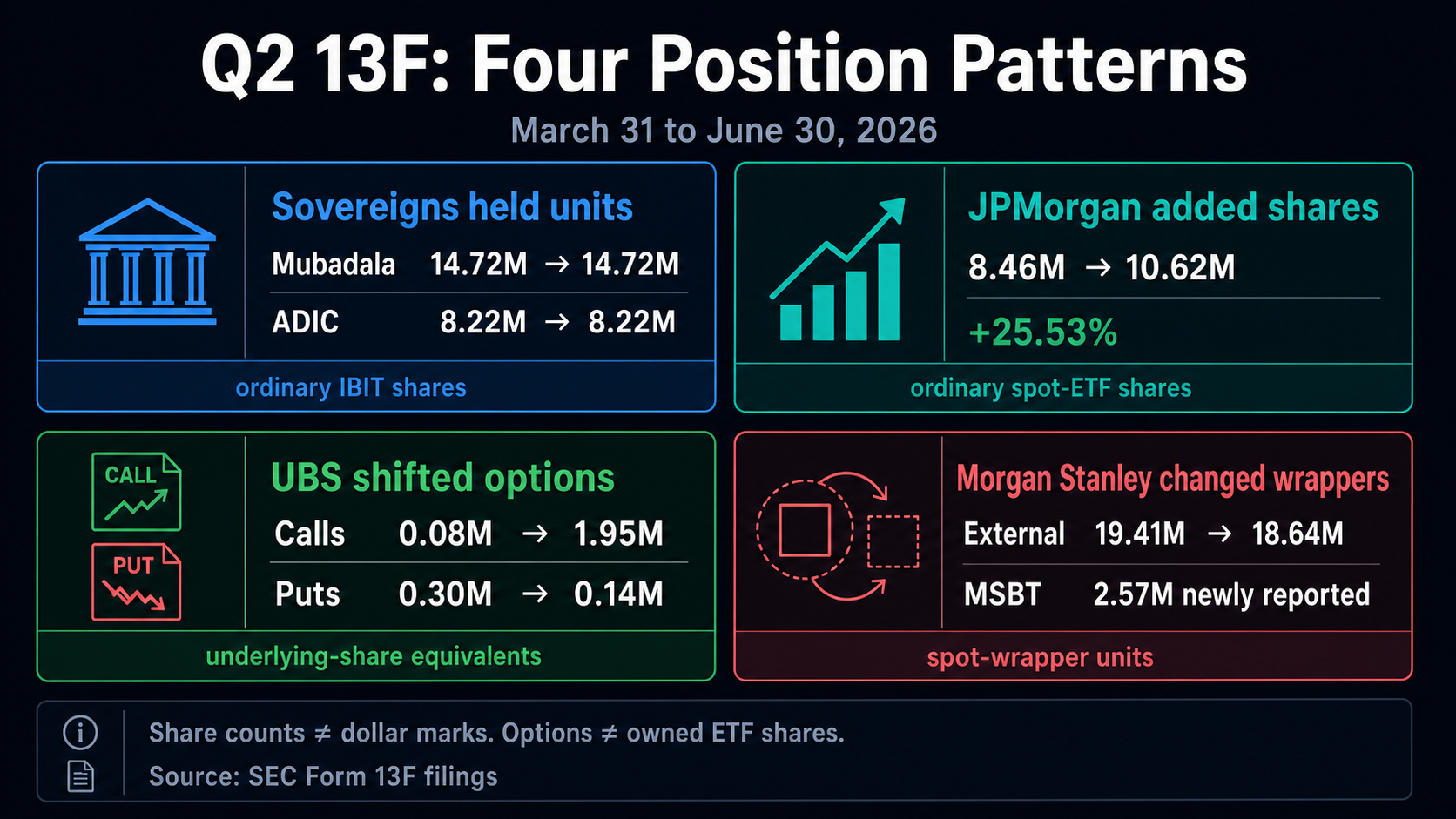
The sovereign row is the clearest case of investors absorbing a lower mark. Mubadala held 14,721,917 shares of BlackRock’s iShares Bitcoin Trust at both March 31 and June 30, while ADIC held 8,218,712 shares at both snapshots. Their reported market values fell anyway: Mubadala’s position declined from $565.6 million to $490.1 million, and ADIC’s moved from $315.8 million to $273.6 million.
Each position lost about 13.35% of its reported value with no net share-count reduction between quarter ends. The identical unit counts identify price revaluation as the source of the lower marks. Two snapshots still leave room for intra-quarter sales and repurchases, and they say nothing about any direct Bitcoin positions. By June 30, however, the disclosed sovereign IBIT holdings matched their March 31 share counts.

Bank books split across shares, options and wrappers
JPMorgan’s filing supplied the clearest ordinary-share increase. Its spot Bitcoin ETF holdings rose from 8,462,883 shares in the amended Q1 restatement to 10,623,591 in Q2. IBIT drove most of the move, increasing from 8,302,691 to 10,407,635 shares.
The options rows moved on a separate track. JPMorgan’s IBIT call underlying amount rose from 3,775,000 to 3,945,000 shares, while its put underlying amount fell from 4,756,400 to 3,495,800. Form 13F instructions express reported options in underlying-security terms, so those figures represent neither contract counts nor ordinary ETF ownership.
Morgan Stanley’s external spot-ETF holdings moved the other way, falling by 775,301 units to 18,636,055. IBIT alone declined by 783,343 shares. The Q2 filing also reported 2,570,627 shares of Morgan Stanley Bitcoin Trust, a row absent from Q1.
Counting the branded trust alongside the external ETFs yields 21,206,682 spot-wrapper units, 9.25% above the Q1 external-fund total. That cross-wrapper comparison shows the scale of the newly reported product, while the two snapshots leave its origin unresolved. They do not connect the reduction in outside funds to the appearance of the branded trust or prove that the same accounts moved between products.

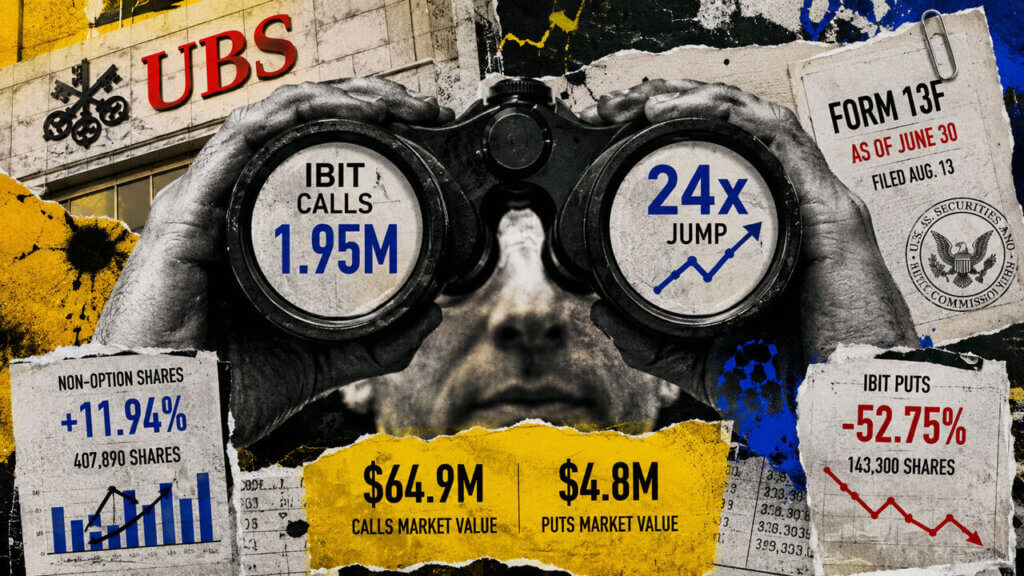
UBS produced the largest reported unit change in held long options. Its ordinary spot-ETF holdings rose 13.20% to 414,191 shares, while IBIT call underlying equivalents climbed from 80,000 to 1,950,000 and put equivalents fell 52.75% to 143,300. The option amounts signal a sharp change in the disclosed long-options mix, with no basis for describing the calls as 1.95 million purchased IBIT shares.
Account ownership adds another boundary. The SEC’s Form 13F guidance allows managers to report securities held for their own accounts alongside assets managed with investment discretion for private clients, mutual funds, pensions, trust departments and controlled entities. Morgan Stanley, JPMorgan and UBS may therefore combine several kinds of managed capital. Their filings establish the manager-level rows, not whether a particular position belonged to clients or the banks themselves.
The same guidance excludes short positions and written options. Without that missing side, the JPMorgan and UBS rows cannot establish either firm’s net Bitcoin direction. The visible call and put changes are pieces of an options book, not a complete directional bet.
Forced-sale evidence sits at the wrapper level
No named filer disclosed a margin call, client withdrawal, mandate breach or forced liquidation. The observable pressure sits in the aggregate ETF data: the fund complex recorded about $4.89 billion of Q2 net outflows, including about $2.06 billion during June’s final five trading sessions. Farside’s totals identify the wrapper-level flow, while offering no link to the five managers in this filing set.
Each cohort could still transmit selling through a different mechanism. Model portfolios can trim allocations after rallies to return to target bands, and collateral stress can force leveraged holders to liquidate during drawdowns. As CryptoSlate previously reported, new contributions, wider bands, options or tax-aware placement can reduce the need for those sales.
Client withdrawals and portfolio constraints are possible channels inside discretionary bank-managed accounts, but the filings show no such event. Expiry, exercise and dealer hedging can also generate flows around options positions, although the omitted strikes, expirations, premiums, shorts and written options prevent this data from sizing their direction.
The completed Bitcoin ETF stress test therefore moves forced-sale risk away from a single “institutional exit” story. Sovereign snapshots showed no net share reduction. Bank-managed rows remain subject to client and portfolio rules hidden from public view. ETF net outflows registered at the wrapper level, while options can transmit flows on a different schedule from ordinary fund shares.
One drawdown met several structures with different owners, constraints and clocks. The useful signal is the separation among them.


